
Oak Wilt in Austin: Signs, Spread, and What Homeowners Can Do
Oak Wilt in Austin: Signs, Spread, and What Homeowners Can Do
Oak wilt is the most destructive tree disease in Central Texas, and Austin sits at the epicenter of its range. The fungus Bretziella fagacearum has killed millions of oaks across the region and continues to spread through neighborhoods, creek corridors, and parks. Understanding how it moves and how to recognize it early is one of the most important things an Austin homeowner with oaks can do. Unlike many tree diseases, oak wilt can be managed — but only if you act quickly and correctly.
How Oak Wilt Spreads
Root Grafts: The Primary Threat
The most common and devastating transmission route is through root grafts — natural connections between the root systems of nearby oaks of the same species. Live oaks commonly graft their roots with neighboring live oaks, allowing the fungus to move underground from an infected tree to its neighbors invisibly and rapidly. An infected live oak can transmit the disease to every connected tree in a grove, causing a spreading center of death that grows outward by 75 to 100 feet per year. This is why you see circular or arc-shaped patterns of dying oaks in infected areas.
Sap Beetles: The Long-Distance Vector
A second, less common but important transmission route is through sap-feeding beetles that carry fungal spores from infected trees — particularly the fungal mats that form under the bark of recently dead red oaks — to fresh wounds on healthy oaks. This is why the pruning moratorium for oaks in Central Texas runs from February through June, the period when beetle activity peaks. Any fresh pruning cut on an oak during this window is a potential infection point.
How to Recognize Oak Wilt
Live Oak Symptoms
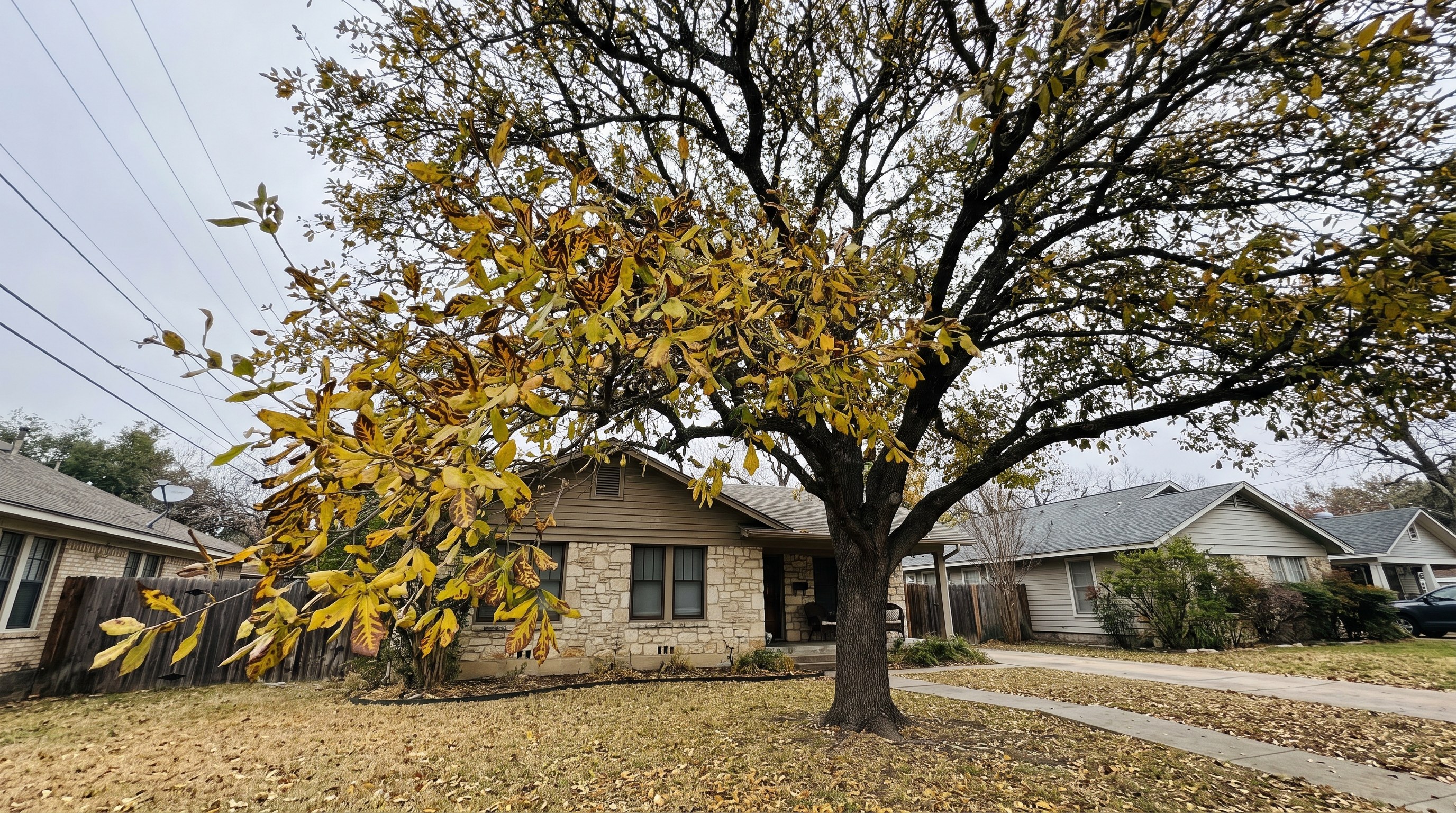
Live oaks infected with oak wilt typically show veinal necrosis — a distinctive discoloration pattern where leaf veins turn yellow or brown while tissue between veins remains green initially. Affected leaves drop while still partially green, often in large quantities rapidly. The canopy thins from the outer edges inward and from the top down. A live oak that drops leaves rapidly in spring or summer with this leaf pattern should be evaluated for oak wilt immediately.
Red Oak Symptoms
Texas red oaks and Shumard oaks typically decline and die very rapidly after infection — sometimes within weeks of first showing symptoms during the growing season. Leaves wilt and turn brown from the tips inward, and the entire tree may be dead within one to three months. Red oaks die so quickly that fungal pressure mats can form under the bark of dead trees within months, creating a spore source for beetle transmission.
What You Can Do
Trenching to Stop Root Spread
When oak wilt is confirmed in an area, trenching to sever root grafts between infected and healthy trees is the primary tool for stopping its underground spread. The trench must be at least four feet deep and positioned correctly relative to the infection center. This is not a DIY project — placement errors mean the disease continues to spread through intact grafts. Done correctly by a professional, trenching is highly effective at protecting healthy trees adjacent to a diseased grove.
Propiconazole Injections
High-value oaks can also be protected with systemic fungicide injections using propiconazole, a treatment that requires a licensed pesticide applicator. Injections are most effective as a preventive measure for healthy trees adjacent to known infection centers, or as a therapeutic treatment for trees in early-stage infection. They are not effective on trees already showing severe symptoms. If you suspect oak wilt on your property, contact Agave Tree Services for a prompt assessment. Time genuinely matters with this disease.
Read More
Get Started with Professional Tree Removal Today
Call us now or request a quote online for the best tree service in Austin.


