
Tree Cabling and Bracing: When Structural Support Makes Sense for Austin Trees
Tree Cabling and Bracing: When Structural Support Makes Sense for Austin Trees
Some trees have structural defects that can’t be fully corrected by pruning alone — co-dominant stems that have grown too large to remove safely, overextended limbs spanning structures or high-use areas, or split unions that have partially failed. In these situations, cabling and bracing systems can reduce the risk of failure and significantly extend a tree’s useful life. But these systems are frequently misunderstood, misapplied, and oversold. Here’s an honest look at when they make sense and when they don’t.
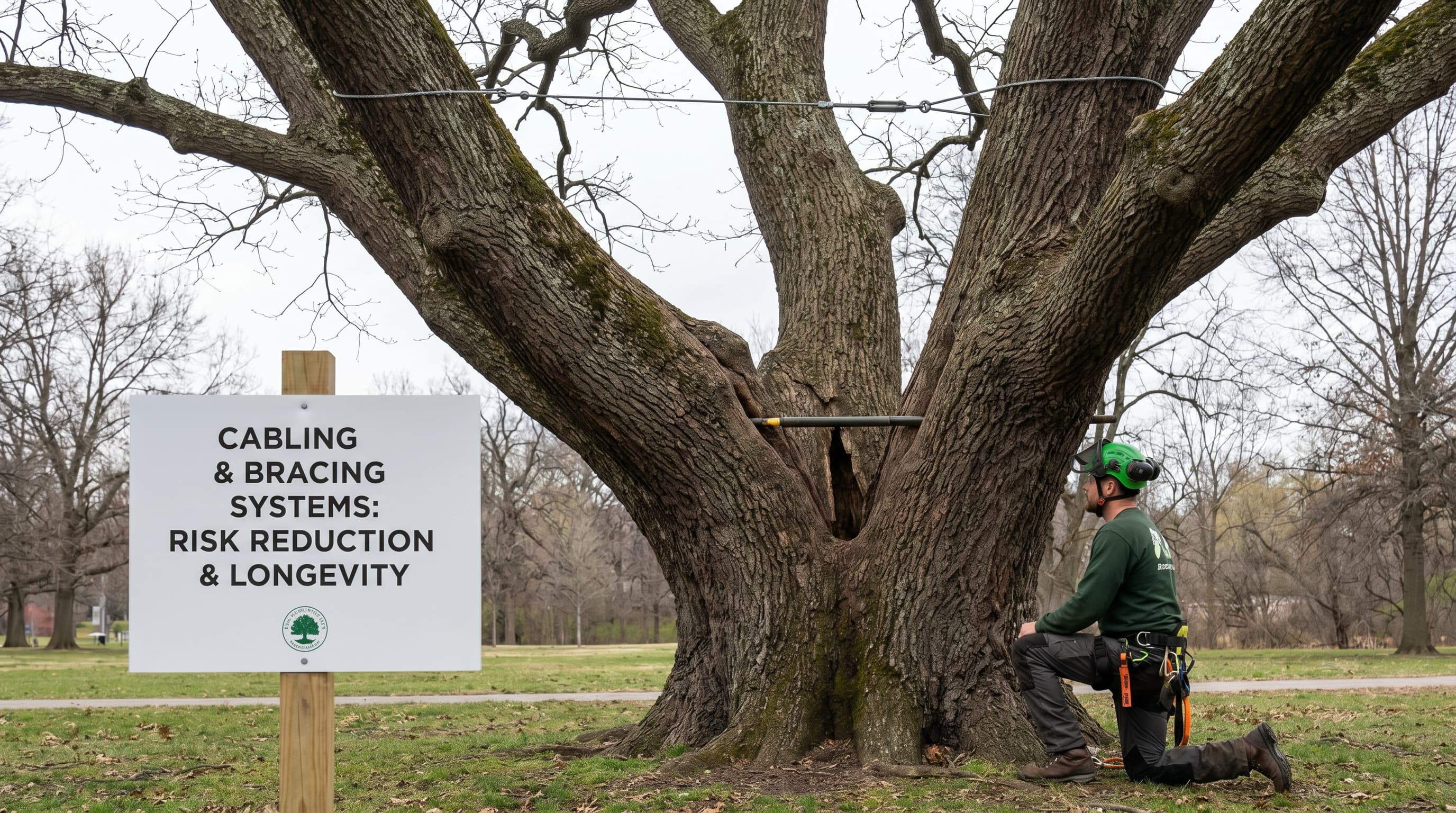
What Cabling and Bracing Actually Do
Cabling
A cabling system installs high-strength flexible cable between major limbs or stems, typically in the upper third of the canopy. The cable limits the range of motion between supported stems under wind and ice loading, reducing stress on a weak attachment point during dynamic events. Modern cabling systems use flexible steel or synthetic rope attached via eye bolts installed through the wood — they allow natural movement while providing a limit on extreme displacement.
Bracing
Bracing uses threaded steel rods installed through a split union or cracked attachment to hold the failing connection together under load. Bracing is more invasive than cabling and is typically used for crotch splits or partially failed attachments where the goal is to stabilize an existing fracture. Bracing is often used in combination with cabling for maximum structural support.
Good Candidates for Cabling
Co-Dominant Stems with Included Bark
The most common cabling application in Austin is a mature tree with two or more co-dominant stems growing at a narrow angle with included bark at the union. If the stems are too large to remove without destroying the tree’s value, and the tree is in a location where failure would be consequential, cabling is a reasonable risk reduction measure. It’s important to understand that cabling reduces risk — it does not eliminate it. A cabled tree still needs ongoing inspection and the cable system itself requires periodic assessment.
Overextended Limbs Over High-Value Targets
A long, heavy lateral limb extending over a house, patio, or vehicle that can’t be safely shortened without disfiguring the tree is a reasonable cabling candidate. End-weight reduction pruning combined with a cable back to the main stem can significantly reduce failure probability while preserving the tree’s canopy and value.
When Cabling Is Not the Answer
Advanced Decay at the Union
If the union being supported has significant decay — soft wood, visible rot, or fungal growth — cabling cannot provide meaningful support. The anchor points for the cable must be in sound wood. Cabling a decayed union gives a false sense of security while providing little actual risk reduction. In these cases, removal of the compromised stem or the entire tree is typically the right recommendation.
A Substitute for Necessary Removal
Cabling is sometimes proposed as an alternative to removing a tree that actually needs to come down. A tree with advanced structural failure, root zone problems, or severe decay is not a good cabling candidate regardless of how much the homeowner wants to save it. A cable system on a fundamentally unsound tree creates the impression of safety without the substance of it. At Agave Tree Services, we install cabling systems where they genuinely make sense — and we tell you honestly when they don’t.
Read More
Get Started with Professional Tree Removal Today
Call us now or request a quote online for the best tree service in Austin.


