
Watering Your Austin Trees Through July and August: A Practical Guide
Watering Your Austin Trees Through July and August: A Practical Guide
July and August are the months that separate trees that will survive Austin from those that won't. Daytime temperatures regularly exceed 100 degrees, rainfall becomes rare or nonexistent for weeks at a stretch, and evaporation rates are at their annual peak. Trees are losing water through transpiration faster than most root systems can replace it — and the decisions you make about supplemental irrigation during this window have real consequences that show up in August dieback, fall leaf drop, and long-term structural decline.
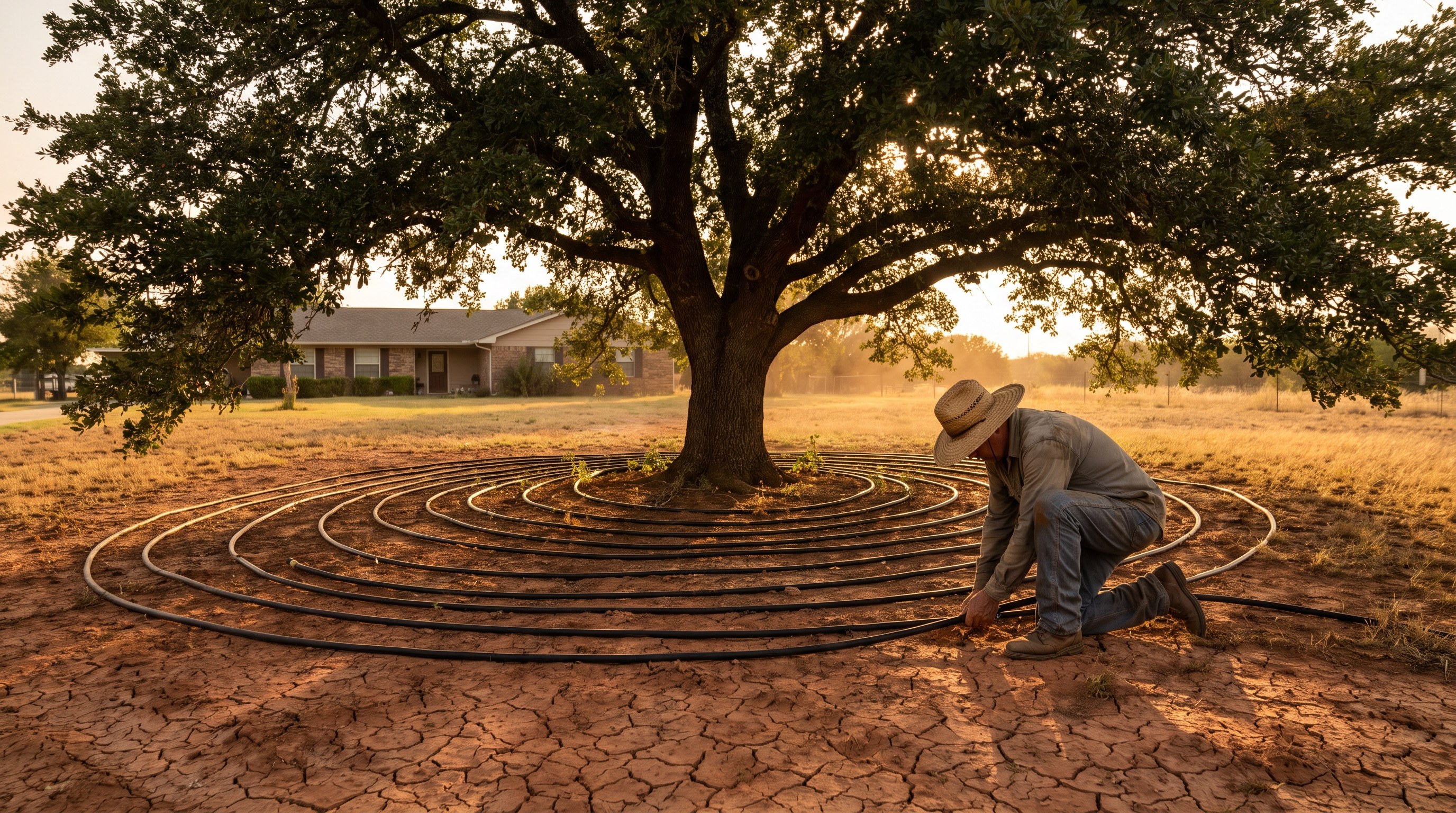
The Core Principle: Deep and Infrequent
Why Shallow Watering Makes Things Worse
Frequent shallow watering — a quick sprinkler pass every other day — trains roots to stay near the surface where they're most vulnerable to heat and drought. Surface soil in direct sun can reach 140 degrees Fahrenheit in July, which is lethal to fine feeder roots. Trees watered this way develop shallow root systems that require constant irrigation to survive, and they're the first to fail during a water restriction period or a landlord who forgets.
What Deep Watering Looks Like
Effective deep watering means getting water down 12 to 18 inches into the soil — the depth where feeder roots are most active and where soil temperatures remain tolerable even in peak summer. This requires applying water slowly enough that it penetrates rather than runs off. A soaker hose laid in a circle at the drip line and left running for two to three hours accomplishes this. A slow trickle from a garden hose moved around the drip line over 90 minutes works as well. What doesn't work is a standard oscillating sprinkler running for 20 minutes.
Frequency by Tree Type and Age
Established Native and Adapted Trees
Established live oaks, cedar elms, and other well-adapted native trees in typical Austin clay soil generally need supplemental watering once every two to four weeks during July and August if there's been no meaningful rainfall. Their deep root systems can access soil moisture unavailable to shallower-rooted plants, and over-irrigating established trees is a real risk — promoting root rot and fungal disease in poorly drained clay. The goal is supplemental moisture, not saturation.
Trees Under Stress
Trees showing heat stress symptoms — persistent evening wilting, significant leaf drop, tip dieback — need more frequent intervention. Water these trees every one to two weeks, applying slowly at the drip line. Document changes after each watering. If a tree isn't recovering between waterings, the problem may be deeper than drought stress alone, and a professional assessment is warranted.
Newly Planted Trees
Trees planted within the last two years have not yet established the root systems needed to survive Austin summers without consistent supplemental irrigation. These trees need watering every three to seven days during July and August — frequency depends on species, container size, and soil drainage. Check soil moisture at six inches before each watering; if it's still moist, wait. If it's dry, water now. Missing a week during peak summer can kill a newly planted tree.
Signs You're Getting It Right
A tree responding well to summer irrigation maintains consistent canopy density, shows no new dieback beyond minor leaf margin scorch, and doesn't wilt overnight. If you're watering correctly and still seeing significant stress, the issue isn't irrigation frequency — it's something else worth investigating. Agave Tree Services offers summer health consultations throughout Austin and the surrounding Hill Country. If your trees are struggling despite your best efforts, let's take a look together.
Read More
Get Started with Professional Tree Removal Today
Call us now or request a quote online for the best tree service in Austin.


